
Against Rigour
Jean-Luc Godard's Film Criticism

At least a few times each year I pick Godard on Godard off the shelf and enjoy the Great Man’s collected film criticism the way I imagine he meant it to be consumed: skipping around, re-reading favourite passages, struggling through others, and sometimes throwing the book down in defeat. I bought my copy when I was in my early twenties, and for a long time considered it mostly just furniture. When I would try to read it, I quickly grew frustrated—by Godard’s recklessness and hyperbole; by his inability to follow an argument from point A to point B; by his dense thicket references; by his general lack of intellectual rigour. But as the years went on, I realized that Godard had written or spoken at least ten or 20 or maybe 30 or maybe even more individual sentences or paragraphs of film criticism that implanted in my brain like seedlings and, over time, grew. Maybe there’s something to be said for a critic who isn’t stressed about making an airtight case, and whose work serves as “a terrain for thought,” as my colleague Luke Savage once described Godard’s video 2 x 50 Years of French Cinema (1995).
Take, for example, the opening of his classic review of Nicholas Ray’s Hot Blood (1956), one of the director’s less-admired films, in Cahiers du Cinema:
If the cinema no longer existed, Nicholas Ray alone gives the impression of being capable of reinventing it, and what is more, of wanting to. While it is easy to imagine John Ford as an admiral, Robert Aldrich on Wall Street, Anthony Mann on the trail of Belliou la Fumre or Raoul Walsh as a latterday Henry Morgan under Caribbean skies, it is difficult to see the director of Run for Cover doing anything but make films. A Logan or a Tashlin, for instance, might make good in the theatre or music-hall, Preminger as a novelist, Brooks as a school-teacher, Fuller as a politician, Cukor a Press agent—but not Nicholas Ray. Were the cinema suddenly to cease to exist, most directors would be in no way at a loss; Nicholas Ray would. After seeing Johnny Guitar or Rebel Without a Cause, one cannot but feel that here is something which exists only in the cinema, which would be nothing in a novel, the stage or anywhere else, but which becomes fantastically beautiful on the screen. Nicholas Ray is morally a director, first and foremost.
“Nicholas Ray is morally a director, first and foremost” is the kind of statement that any editor worth their salt would ask a writer to justify, but Godard just speeds right along. His refusal to justify gives it force—Nicholas Ray being morally a director is just axiomatic. But be careful before you try this at home, kids, because not all hyperbole is the same. A Buzzfeed headline from 2016 declaring some Disney slop the Best Thing Ever is not going to stay in anyone’s memory, except maybe for the wrong reasons. Godard had the kind of mind that capable of surprising observations and evocation connections—like saying John Ford could have been an admiral but Nicholas Ray could only have been a director.
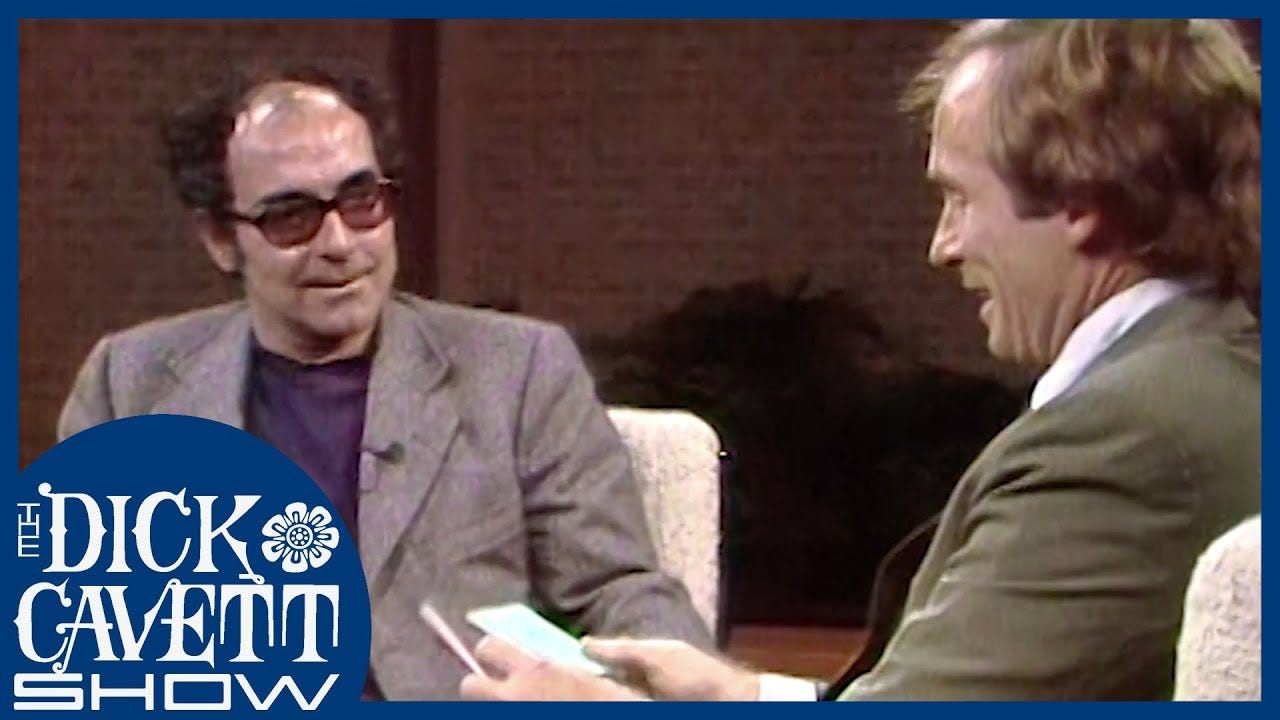
My favourite bit of Godardian criticism came during his visit to The Dick Cavett Show in 1980, to promote Every Man for Himself. The host raised the issue of French intellectuals’ admiration for Jerry Lewis—long a running joke for middlebrow Americans—but Godard answered the question with admirable seriousness. After reminding Cavett that he and his Cahiers compatriots boosted the artistic reputations of Hitchcock and Hawks, he said of Lewis: “He’s more a painter, really, than a director. … He’s working with space. He’s not working like all those so-called ‘modern moviemakers’ and making fancy with the camera. He’s just interested in framing. He’s a very good framer, like a painter. He has a good sense of geometry. To be a comic, you have to be very capable in geometry.” By 1980, Lewis’s critical and popular reputation in the United States was very much in eclipse, so to hear him compared to a great painter might have struck many viewers as stereotypical French contrarianism—unless, of course, they bothered to think about the chair-arranging scene in The Bellboy or the dollhouse-set reveal in The Ladies Man. Godard didn’t cite these examples in the interview, and that’s fine, because a statement like “He’s more a painter, really, than a director” gives the listener enough room to collaborate. Godard concluded his riff on Lewis by half-jokingly observing, “Even when he’s not funny, he’s more funny”—a useful one-sentence key to unlocking the prickly art of Monsieur Lewis.
By 1980, it had been many years since Godard had written a conventional movie review, although he told Cavett that he still considered himself a critic. In a contentious 1981 debate with Pauline Kael, Godard argued that prose criticism was insufficient in providing necessary visual “evidence” (“I need to be criticized, but with good evidence. If I were to commit a crime I would need evidence from you proving whether or not I had a reason to commit the crime”), and while this struck Kael as mere perversity, Godard found a way to put the idea into practice with his monumental video essay Histoire(s) du Cinema (1988-1998). In episode 4a, about Alfred Hitchcock, Godard notes that we don’t remember in Notorious why Ingrid Bergman was hired by the U.S. government, but we do remember the bottles in the closet. He then compares Hitchcock’s objects (a bus in the desert, a pair of glasses, a clutch of keys) favourably to Cezanne’s apples, calling him “the greatest creator of forms/shapes of the twentieth century.” And then he goes even further, saying: “Through them, and with them, Alfred Hitchcock succeeded where Alexander, Julius Caesar, Hitler, Napoleon failed: he took control of the universe.” You can decide where on this elevator of hyperbole you choose to get off, but I’m going all the way to the penthouse.
One of the theses of Histoire(s) du Cinema is that cinema was forever damned by the Second World War and Holocaust—by the medium’s failure to prevent or properly document the wartime atrocities, and by the failure of Europe’s film industries to counter the tide of American imperial monoculture. You won’t hear Godard state his ideas quite so directly, but you will see familiar images from film history problematized and rendered strange. In the first episode, Godard imposes an image of Elizabeth Taylor in A Place in the Sun over the aftermath of the death camps. It’s a startling, upsetting juxtaposition that could be mistaken for trivializing the Holocaust, but which I think really underlines the ever-presentness of the historical trauma. For his part, Godard told Gavin Smith in an interview for Film Comment, “George Stevens had shot the Holocaust, kept it hidden away for many many years in his cellar, but when he was shooting A Place in the Sun there was kind of both smile and disaster. Even if it’s not an extraordinary film, it’s very intense, and you can’t explain it. None of the other pictures George Stevens made after [were as good].”
As a critic, Roger Ebert was Godard’s opposite: lucid, commonsensical, striving to be fair, and basically untroubled by the dominant cinema. A telling bit of Ebert prose is when he calls Film Socialisme “heedless of the ways in which people watch movies,” as if there were only one way. Ebert was fond of quoting an alleged Godard maxim, “The best way to criticize a movie is to make another movie” (a slight bastardization of “Instead of writing criticism, I make a film”), and found it useful when explaining why Shanghai Noon was better than Wild Wild West, but he chafed at Godard’s swipes at Schindler’s List in Éloge de l’amour (2001). In that film, an American company called “Spielberg Associates” buys the memories of Holocaust survivors in Europe. Ebert called the attack “painful and unfair,” which of course it is. Sometimes the Ecstatic Truth hurts.
"In that film, an American company called “Spielberg Associates” buys the memories of Holocaust survivors in Europe"
Holy fucking shit. I kmow very little about Godard but I can see that the guy had no chill
Omg you have to come to the Godard/Jerry Lewis retro at Anthology