
Notes From My Most Recent Viewing of Eyes Wide Shut
"Alice. I happen to be a doctor."

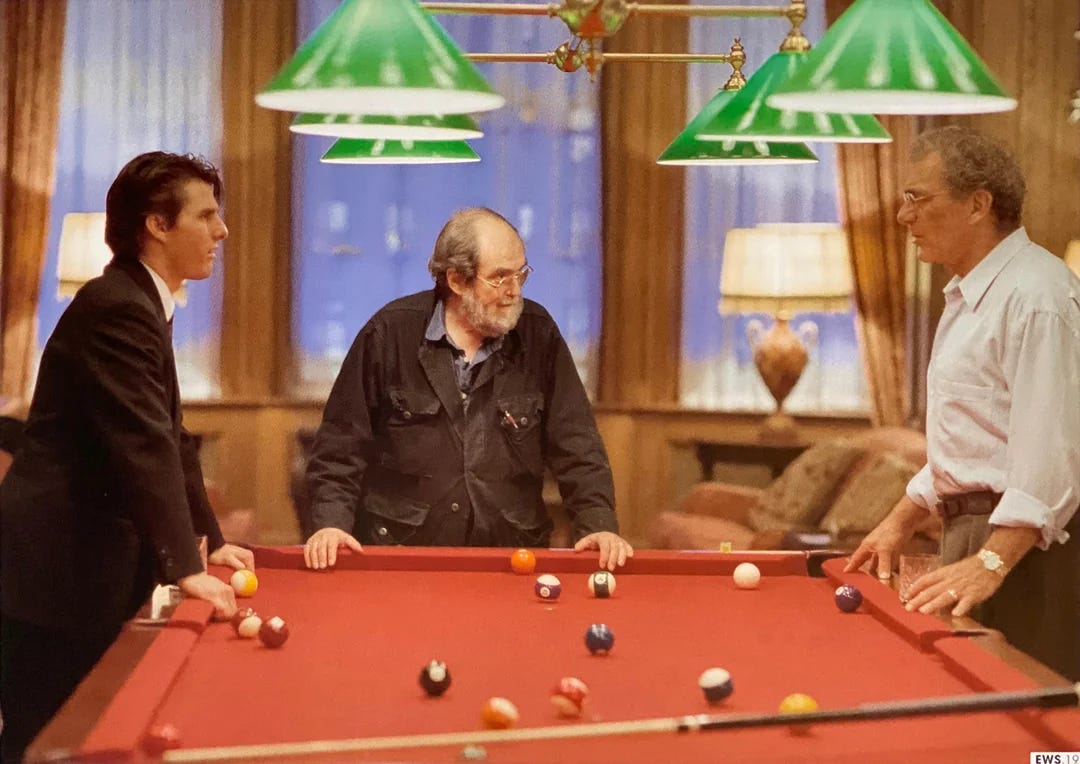
Did you know that Kubrick supposedly (and probably very briefly) considered casting Woody Allen in the Tom Cruise role? Certainly would have been interesting in light of the Woodman’s links to the real-life Victor Ziegler, Mr. Jeffrey Epstein. I assume Allen, who is rich but not a billionaire, probably played a similar role in Epstein’s social circle that Dr. Bill plays in Ziegler’s (being that rich allows you to buy a bit of color for your social landscape). Dr. Bill is acutely aware of his class position when he’s around Ziegler, and so spends the rest of the movie trying and failing to establish dominance over the working-class characters by flashing his medical license like a badge and solemnly announcing “I’m a doctor.” A very funny running joke that only started to click with me after a few viewings is that nobody cares.
Speaking of Woody, I was reminded on this viewing a little of Crimes and Misdemeanors in the way that Kubrick brings together and finds connections between two stories of disproportionate moral weight: a marital crisis, and the shadowy machinations of an elite sex-trafficking ring. Both stories feature powerhouse two-hander dialogue scenes in which Dr. Bill is put in his place and told that he doesn’t really know anything—first by his wife, then by Ziegler. The realization that he has become complacent in his marriage inspires Dr. Bill to take a big swing and start snooping around a criminal enterprise; the enterprise responds by slapping his wrists and sending him scurrying home. You’re in too deep, Bill. Maybe just focus on your marriage.
The Epstein angle has been a significant contributor to the film’s rapid rise in the canon. Remarkable how most critics in 1999 focused only on the troubled-marriage plot and not the sex-trafficking mystery, which occupies much more of the runtime. It seems like people just didn’t understand what they were looking at, and responded by calling Kubrick an out-of-touch old hermit. In one of her last interviews, Pauline Kael called the film “ludicrous from the word go,” and said, “That orgy was the most hygienic thing I've ever seen. It was strangely decorous. What was that all about, and who were these people that they had the money to stage such things?” How little she knew.
Speaking of the marriage plot: When I first saw Eyes Wide Shut—17-years-old, still in high school, never had a girlfriend, didn’t know anything about anything—I didn’t understand why Alice’s confession about the sailor sent Dr. Bill into such a tailspin. She didn’t even cheat on him, she just had a thought once! Now that I’m in my thirties, I get it. When Dr. Bill loudly affirms his faith in his wife’s faithfulness, and she calls it out as just a manifestation of his own self-regard and deep-rooted complacency... The shock that his wife—his wife—might have feelings and even desires that exist independently of, or parallel to, her feelings about him… Kubrick hit on something very real here, is all I’m saying.
“Less is more.” Kubrick does not subscribe to this motto. The production design is overflowing and fussed-over. All the things that are supposed to be functionally invisible—bookshelves, Christmas lights, paintings on the wall—are jarringly present, competing for the viewer’s eyeballs with the foreground action. Knowing Kubrick’s fastidious working methods—that he was the kind of person to read every book about the history of orgies before attempting to depict just the right orgy—adds an air of mystery around his intentions, since he’s clearly not going for realism. The look of the film corresponds with the stiff and uncanny performances of the actors, and the strange ways Kubrick went about coaxing them. Did he really need 1,000,000,000,000 takes of Cruise at Pollock’s pool table to get that overly-formal quality in their performances? All I know is, it worked.
The extras on the Criterion release include an interview with Lisa Leone, who was officially the set decorator but who served as Kubrick’s eyes in New York City, because he refused to travel. She sent him hundreds and hundreds of photos of the West Village, which they discussed over the phone in unsparing detail, and which informed the massive fake New York sets he built in London... which look, frankly, about as much like Manhattan as the “New York New York” Hotel in Las Vegas does. The movie is called “Eyes Wide Shut” so I think we can assume Kubrick was aiming for a dreamlike quality… although I’ve found that challenging to reconcile with all the clunky second-unit shots of the real Manhattan. Of course, Kubrick died before anyone could coax any explanations out of him, which is just one reason why this strange and mysterious film continues to percolate with each passing year.
Absolutely superb piece!! This pic is endlessly rich and <i>essentially</i> renavigable.
I find the "I'm a doctor" running gag hilarious, but I see it quite differently than you do. It does work - Bill pulls it mostly to people of classes lower than his. It's a narrative device that explains why he can proceed to circles where he should not : he can attest to a respectable profession & respectable connections, as well as some intimate knowledge of people, when looking for a costume, asking for his friend at the hotel, etc. What crack me up every time is that he uses this phrase to reassure people and project respectability, but it's also an act ; and that he clings to that act of the reassuring nice doctor also to reassure and ground himself while he's more and more lost and confused, and behaving more & more idiotically.
On a sadder note, being a doctor is also what saves him : of course Maddy will get the nice, reassuring, clueless doctor out of the abyss she's in, he tried to help her and he can still be rescued.
As for the dreamlike quality, it's indeed obvious, all the more as the film is adapted from Arthur Schnitzler's Traumnovelle, aka the Dream Novel.