
Whore (1991)
On Ken Russell's non-classic

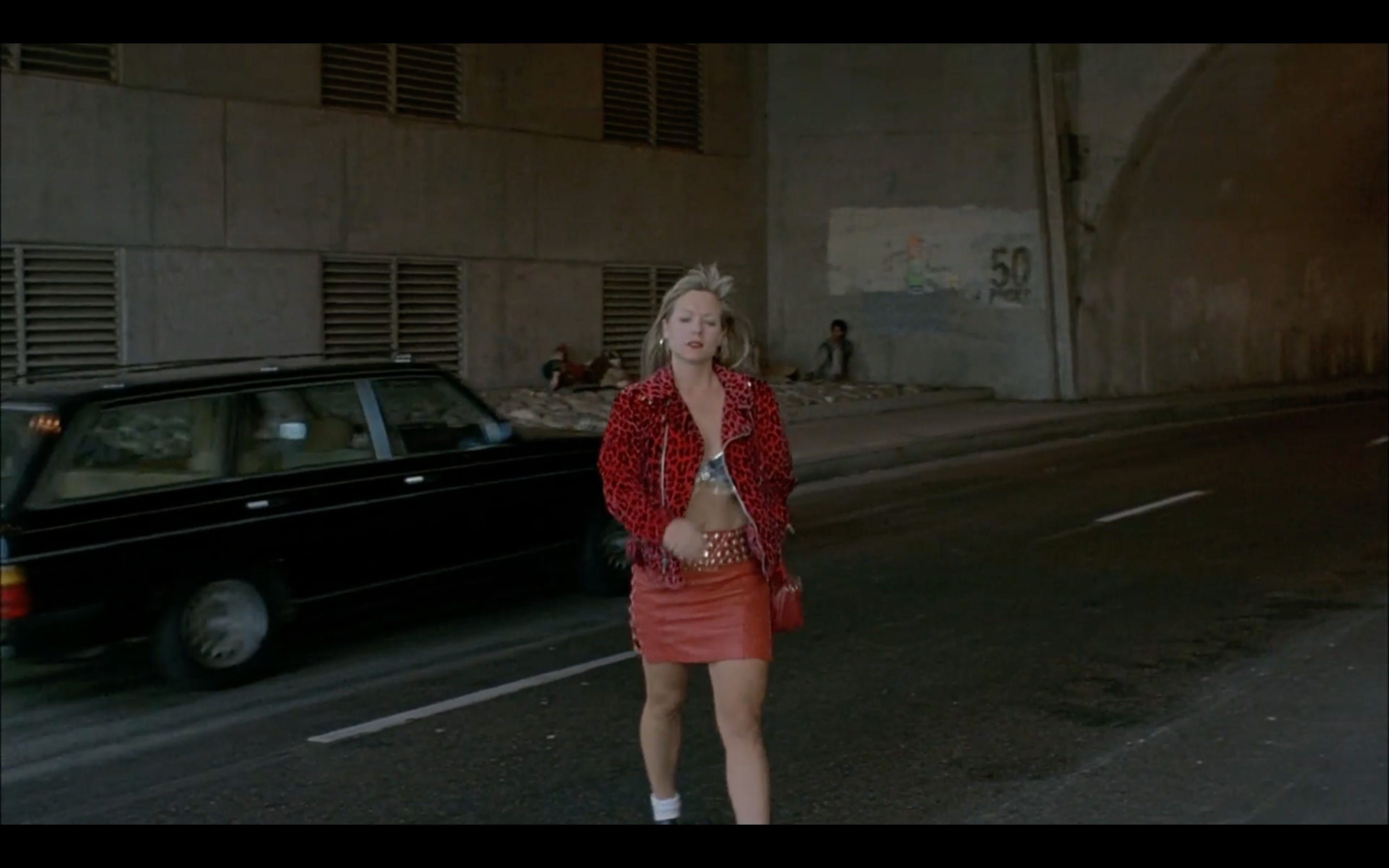
I had been meaning to watch Ken Russell’s Whore for a long time, because the idea of the director of The Devils making a hard, angry seriocomic rebuttal to Pretty Woman is a bizarre and memorable pitch. My main mental obstacle has been the film’s reputation as a failure. I like a good film maudit as much as the next guy, but one only has so much time. The new Kino Blu-Ray seemed as good an opportunity as any to rectify this not-very-pressing blind-spot, especially because the disc has a bonus feature detailing the differences between the R, NC-17, and Unrated versions. I was grateful to have these minor variants laid out in 15 minutes so I wouldn’t have to fret over which version of this poorly-received movie is the “right” one.
Whore lives up to its reputation as being bad in a lot of obvious ways, but it held my attention and that has to count for something. Theresa Russell stars as Liz, the title character, and narrates the movie directly to camera virtually nonstop. It’s a demanding role performed very broadly, and like so much memorable acting it exists on the knife-edge of magnetic and annoying. Liz works at street corners, not escort agencies, which leads to a lot of encounters with troubled men – some violent, some merely strange. The undergirding drama is her attempt to evade the clutches of her abusive pimp, Blake (Benjamin Mouton), but mostly the movie is a procedural about life on the streets. Throughout, Ken Russell maintains a blackly comic tone, shooting the assault scenes matter-of-factly, which is also how the protagonist discusses them.
Nowadays, a lot of the film’s queasy fascination comes from it being such an obviously problematic text unthawed in a fraught cultural moment. Discourse about sex work has evolved a lot in the last 34 years; today, a veteran male director taking it upon himself to correct a sanitized movie like Pretty Woman would be greeted with the rejoinder that sex workers are more than capable of speaking for themselves. It might be levelled at Russell that his White Knighting helps mostly to further stigmatize an already marginalized class of people. Also, given that Julia Roberts’ character in Pretty Woman quite literally calls her story a “fairy tale,” it’s funny that Russell thought audiences needed to be reminded that sex work can be unpleasant.
But as much as discourse has changed, the arc of progress is not always linear. The Happy Hooker, by the unrepentant Xaviera Hollander, was a mega-bestseller in the ‘70s, while the start of a second Trump term probably doesn’t bode well for sex workers today. The big sex-work movie of the current moment is Sean Baker’s Anora – rapturously received by the official organs of film culture, but a contentious discourse-magnet in the social media circles wherein I hobnob. Some of the dissent has come from a bubbling skepticism of Baker himself, a man whose now-invisible Twitter “likes” tab suggested a reactionary streak that complicates his image as an empathetic chronicler of the underclasses. Others have asked what it means that a big “progressive” film about sex-work is one in which the heroine is briefly shown a world of luxury before an abrupt, cruel reminder of her class position. A review in Autostraddle by Olivia Hunter Willke provocatively asks, “Would it be so void of pathos or interest simply for an escort to do the work she does because she enjoys and is good at it? Ivan views Ani as a commodity, a plaything. In a film so charged with Ani’s misadventure, I’m unsure if Sean Baker views her any differently.”
I’m in no position to judge the accuracy of any screen depiction of sex work, nor to opine on what sorts of depictions are ideologically “correct.” From the small number of people who have confided their sex-work experiences to me, the only clear consensus I’ve gleaned is that it is work. I am a moderately thoughtful human with a functioning-though-not-infallible bullshit detector, so I would provisionally say that Whore gets a mixed report on the Bullshit-o-Meter. Typical of Theresa Russell’s monologues is one where she remembers reading Animal Farm, “the best book I’ve ever read… well, it was the only book I’ve ever read” – an incredibly lame example of the film’s tendency toward Noble Savage characterization. There is a subplot about her estranged son where the film regrettably breaks kayfabe and indulges in pathos. There is the terrible action-movie finale. In its better moments, Russell thinks holistically: in Liz’s world, the cops are as potentially dangerous as the johns, ready to arrest sex workers for the concealed weapons they carry for self-defense. Lacking above-ground protection and support, pimps serve as a buffer between workers and clients, though the film questions if legalization would liberate workers from exploitation. This film’s pimp, Blake, is a born capitalist who says (while briefly taking over the film’s POV), “If it was legal, I’d open an office.”
I’m still not sure what to do with the film’s various scenes of sexual violence. I suppose there is something to be said for how Russell makes it a brutal but everyday part of the tapestry of life. My buddy Ethan Vestby wrote of the film on Letterboxd, “Kind of horrible at times, definitely a misfire, but uncomfortable and politically incorrect in a way I wish movies still were,” and I think that’s more-or-less where I’m at. I wouldn’t call it a good movie, or even a noble failure, but there’s something to be said for the feelings evoked by something this reckless and un-self-conscious. I’m glad I saw it.
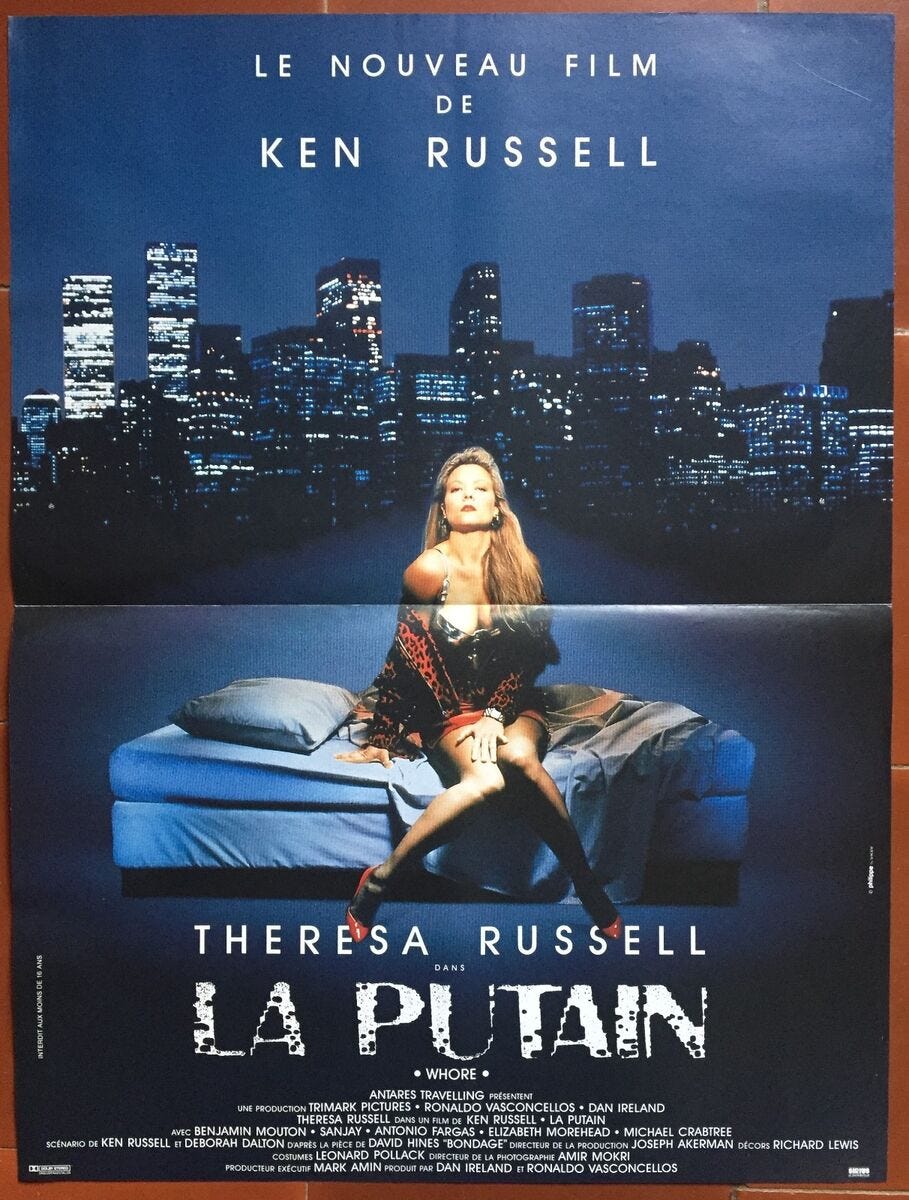
It’s a populated mini genre with few quality entries, but better is Crimes of Passion, which arguably does a better job of exposing its universe by leaning into genre rather than away from it. Wonder why that is
He was so groundbreaking in the 60s and as a lad I was wiped out by his BBC docs on Elgar and Isadora. There was nothing else like it at the time and I will always revere him for that despite some later lapses.