
Palindromes (2004)
On the Todd Solondz abortion movie

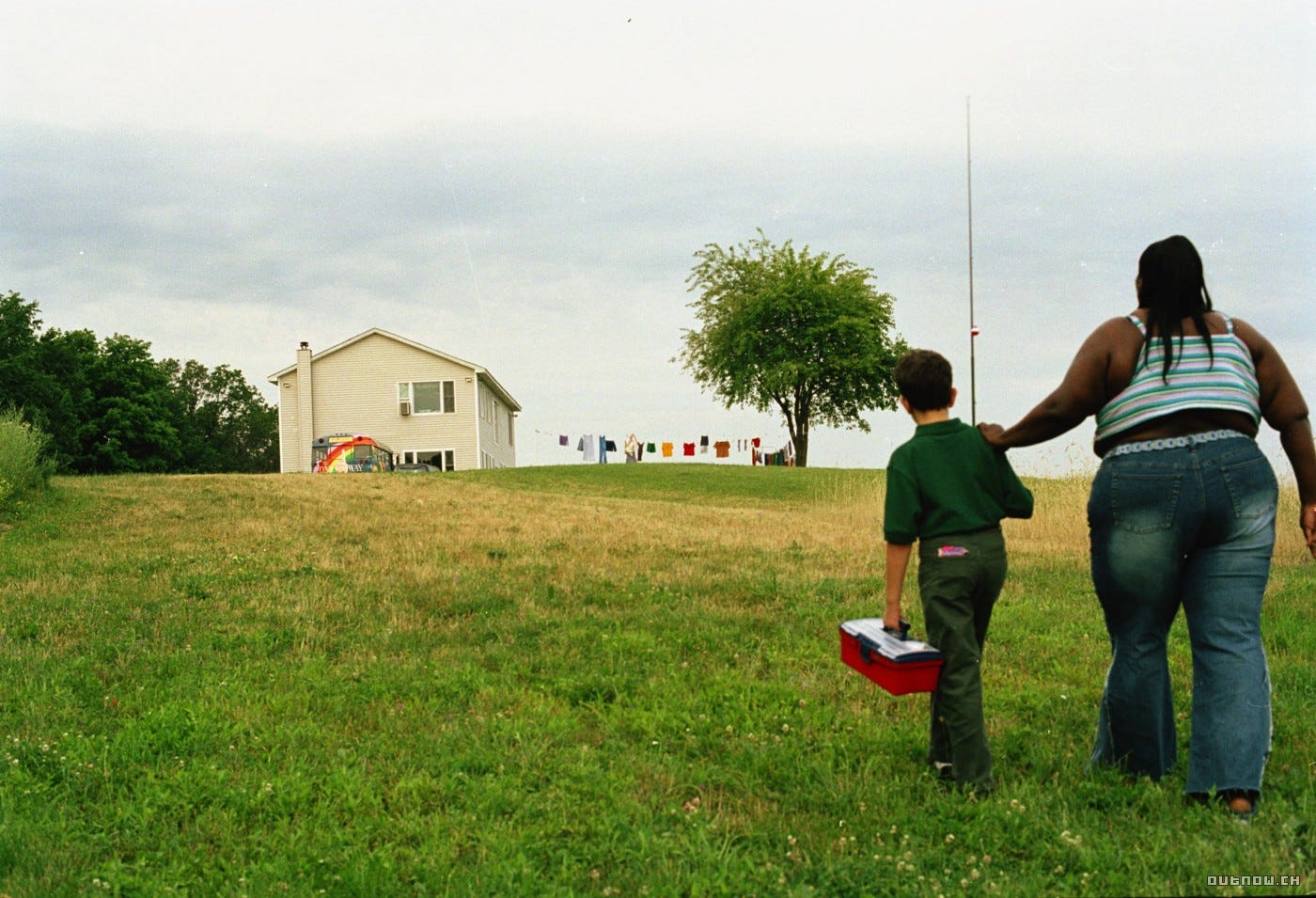
A few nights ago, I revisited Todd Solondz’s Palindromes (2004) via a new “4K restoration” that has been making the rounds at repertory cinemas and on Blu-Ray. Coming a few months after Criterion’s liberation of Solondz’s Happiness (1998) from a decade of legal purgatory, plus a flattering New Yorker profile reaffirming him as “a titan of indie film,” the re-emergence of Palindromes is further evidence of a renaissance for a filmmaker who has spent a long time in eclipse.
I was glad when the maladjusted filmbro protagonist of Chandler Levack’s I Like Movies (2022) namechecked Solondz as a favourite filmmaker, because as a boundary-pushing hero of budding millennial cinephiles, he is sometimes lost in the shuffle between his flashy contemporaries. I associate Solondz’s movies with the basement of my old family home in the Toronto suburb of Etobicoke, and the feeling of anxiety that my parents might walk in the room at any minute. Like David Lynch and John Waters, Solondz was preoccupied with the rot beneath white-picket-fence suburbia, and dealt with transgressive issues in a way that was not simply moralistic (Happiness counts an obscene phone caller and a child molester among its main characters). And also like those filmmakers, Solondz’s provocations are steeped in layers of irony, leading to accusations of deploying sensitive subject matter for mere “shock value.” “Empty provocation pretending to be dialectical humanism” is how critic Elbert Ventura described Palindromes in a brief takedown for Reverse Shot. “Fancying himself a moralist who provokes when he should be sympathetic, ironizes when he should be solemn, Solondz strips his characters of their dignity – and then declares our revulsion as evidence of bobo hypocrisy.”
I saw Palindromes in first run when I was 16, around the height of my interest in Solondz, shortly before disconnecting from his work at a moment that basically corresponded with his broader cultural eclipse. I remember feeling something amiss watching Life During Wartime (2009) during a scene where Alison Janney – playing a version of Cynthia Stevenson’s middle-class suburban housewife character from Solondz’s from Happiness (1998) – comes home from a date with Michael Lerner. Recounting the date to her young son, she loses herself in an erotic reverie, saying “He made me so wet…” before catching herself. I remember thinking to myself, “There goes Todd again. More sex stuff with prepubescent kids. Playing the hits.” I dutifully kept up with the next few Solondz releases, and by the end of Wiener-Dog, when (spoiler) the titular wiener-dog is unceremoniously run over by a car, I had come around to agreeing with his detractors that his films were “empty provocations.” So I wrote him off for a while.
There are obvious reasons why the cultural spotlight has begun swinging back to Solondz. After a decade of heightened anxiety in liberal circles on issues of race, class, and sexual misconduct, not to mention the evergreen industry of right-wing panic surrounding pedophilia, of course there would be renewed appetite for a filmmaker who is so unconcerned with propriety on these matters. Happiness contains a darkly funny scene in which a respectable middle-class family man named Bill Maplewood (Dylan Baker) struggles to drug and rape his son’s friend. This scene plays with the audience’s sympathies in a similar queasy way as the one in Psycho where we find ourselves rooting for Marion Crane’s car to sink into the swamp. In the context of… (*gestures broadly at the world around us*)… it’s a stimulating challenge.
The revival of interest in Solondz’s past work has not yet led to corresponding interest in financiers: he hasn’t made a movie in nearly a decade, and the hook for the New Yorker profile was trying to figure out why. His most famous films, which also include Welcome to the Dollhouse (1996) and Storytelling (2001), sprang from the post-Tarantino golden age of popular “indie film,” when major studios’ specialty divisions that sought the next off-kilter, taboo-busting seriocomedy for discerning adult audiences. Even in that atmosphere, Solondz became too much for the moneymen: Happiness was rejected by Sundance for its extreme subject matter and dumped by Universal Pictures after getting an NC-17 rating. Later, Solondz contemptuously imposed a red square over an explicit sex scene in Storytelling as an anti-censorship gesture after being ordered to cut it for an R-rating. Whatever else you might say about Solondz, you can’t call him a careerist.
Palindromes is Solondz’s most challenging and abrasive film, full of moments that will cause a 2025 audience to reflexively say, “Boy, they couldn’t put that in a movie today…” - except that Solondz had to spend his savings to fund the production, so apparently it wasn’t allowed then either. I remember that when Ebert & Roeper reviewed it on their TV show, Roeper gave it a cautious thumbs-up on the grounds that he wanted more people to see it “so we can compare notes.” I’m more-or-less with him on that. For what it’s worth, this is the Solondz movie that has stuck with me most strongly during my long period of apostasy, so I’d like to use this space to belatedly share my notes.
The film is Solondz’s contribution to the abortion debates of the George W. Bush era, offering an ambiguous perspective on the subject that prods at its grey areas. The plot involves Aviva, a 13-year-old girl who is made to have an abortion, and follows her as she navigates idealogues, predators, and hapless bystanders on both sides of the cultural divide. Like most of Solondz’s films, it is also preoccupied with child molestation, and is unnervingly nonjudgmental of its pedophile characters – or, at least, no more or less judgmental than of anyone else. And like all his films, it’s a comedy. Aviva is played by eight different actors – most are young women, two are black, one is a boy, and one is Jennifer Jason Leigh – which is a distanciation strategy, except that the eight performers together create a seamless character.
I’m going recount the plot and venture into “spoiler” territory. The film begins at the funeral of Dawn Wiener, the protagonist of Solondz’s Welcome to the Dollhouse, who we learn has committed suicide at age 20 after becoming pregnant from a date rape. Her brother Mark gives a teary eulogy and plays a recording of one of Dawn’s musical performances, and hearing the plainly untalented artistic striving of a young suicide victim sets the general atmosphere of bleak, cruel comedy. Dawn’s young cousin Aviva is at the funeral, and, troubled by Dawn’s story, vows to grow up to have many children. We rejoin her some years later when she is 13, and asks a local boy to deliberately impregnate her. Once the situation is revealed, Aviva’s mother Joyce (Ellen Barkin) is adamant that the baby be aborted. While trying to reason with her daughter, Joyce reveals that she herself had a pregnancy terminated after she was born, and that it left her feeling free. Solondz is unforthcoming in his interviews, always careful to place the burden of interpretation on his audience, so my interpretation is: I believe the movie understands that Aviva is not competent to mother a child at 13, but is also sad about the ways that her “choice” is no choice at all. I also believe the movie is quietly judgmental of Joyce’s choice to seek an abortion for financial reasons (among the movie’s many cold, hard little laugh lines is that the family now has more money for NSYNC tickets), and is skeptical of her claim that she doesn’t regret it.
The abortion takes place, but the procedure is botched and Aviva is given an emergency hysterectomy – a truth that Aviva’s parents keep from her. Soon after, Aviva runs away, with the vague plan to become pregnant again. First she is picked up by a truck driver (Stephen Adly Guirgis), who has sex with her before abandoning her at a motel. Soon after she finds her way to the home of Mama and Bo Sunshine, an Evangelical couple whose home has become a foster community for abandoned and unwanted children. One girl is blind due to fetal alcohol poisoning, another was born without limbs, a boy has Down syndrome, etcetera – all traits that have led expectant mothers to terminate a pregnancy. Solondz affirms their humanity of these children, many of them played by people with actual afflictions, but also casts them as merciless parodies of Bush-era Christian conservatives. The kids watch horrible Christian TV and ask for “freedom toast” at breakfast and tour the gospel circuit as a grotesque pop band called The Sunshine Singers (their signature song “Nobody Jesus But You” has haunted me for 20 years). That Solondz depicts his characters as whole, valid people who are also often foolish, dangerously unwell, and actively harmful is one of his strengths as a filmmaker.
We also learn, surprise surprise, that there’s something dark and violent beneath the Sunshines’ sunny exterior. When the family doctor informs Bo Sunshine of Aviva’s condition beneath the waist, he spits: “I’ve never had a slut in my house.” We learn that Bo is the ringleader of a conspiracy to assassinate doctors who perform abortions. By remarkable coincidence, his current target the doctor who operated on Aviva, and his paid assassin is Aviva’s truck driver. Much of the last act becomes about their sick non-relationship, as they enact a quasi-Bonnie & Clyde dynamic while travelling to murder the doctor. I don’t know what to do with all the stuff about pedophilia (in addition to the trucker, we learn that Aviva’s cousin Mark has been accused – falsely, it seems – of impropriety by a younger relative). His sympathies are with outsiders and pariahs, and one of his challenges to the audience is declining to distinguish between them. At the same time, he likes toying with our sympathies: the abortion doctor, a villain for most of the film, suddenly becomes much more human when we see him through the crosshairs of a sniper rifle, playing charades with his family. I can’t know for sure, but I’d wager that the major character he has the least sympathy for is Ellen Barkin’s Joyce, who prioritizes bourgeois comfort and stability above all. If I’m right, I find this a little troubling.
I appreciated Palindromes in 2005, and still appreciate it now, as a rocky terrain for a lot of complicated ideas and truths. I think art can and should be a space for the working through of ambiguities. That said, I wouldn’t necessarily fight back if someone chafed against this, and told me that decades of “ambiguity” – all that “Safe, legal and rare” vacillating so often adopted by Good Liberals to sound Sane and Reasonable – has only helped further devastate abortion rights in the United States. If you told me that, 20 years since Palindromes’ release, mulling over ambiguities is a luxury for someone who will never have to worry about being forced by the state to carry their rapist’s baby to term… well, what could I possibly say except that you’re right?
I was hoping to hear Solondz consider this in the Zoom Q&A that followed last week’s screening at the Paradise Theatre in Toronto, but of course he didn’t. I asked a fairly obvious question: The film is a time capsule of the abortion debate during the Bush era, and many seismic shifts have occurred since; what are his thoughts on this in relation to the film? Solondz’s reply, which I’m paraphrasing, was: While Roe v. Wade was overturned, the basic forces around the abortion debate have remained the same. This is the answer I was expecting, but I don’t think it’s a correct one.
For one thing, the obstacles to Aviva or Joyce procuring an abortion have become a lot tougher than walking through a group of fundamentalists with placards outside the doctor’s office. Now, they might have to cross state lines and lie to government officials, and even if they choose to keep their pregnancies, good luck finding a hospital once the Big Beautiful Bill takes effect. While it’s true that Evangelical Christianity is still the prime mover behind the erosion of U.S. abortion rights, Compassionate Conservatism is long dead as a rhetorical strategy. Under Donald Trump, right-wing politics have taken a more nakedly punitive affect, with Evangelical voters cheering on concentration camps for migrants, a U.S.-backed genocide in Gaza, and the erosion of whatever was left of the social safety net. Palindromes really is a time capsule, because it’s harder than ever to accept that Mama Sunshine would welcome such a large and ecumenical brood of unwanted children. Yesterday’s “right to lifers” are the ones feeding Solondz’s beloved outsiders to the meat grinder.
"I don’t know what to do with all the stuff about pedophilia"-something solondz has probably said when writing his scripts